Thursday, May 21, 2009

Homestay

When we were arranging the trip with the Habitat volunteers based in the Philippines, we asked if it might be possible for them to arrange a homestay for us with a local family.  We were pretty excited when they responded almost immediately that they could do so with no problem.

We were a little more anxious when we found out, just after arriving, that we would be staying not with local people in the city, but with residents of the village.  Don't get me wrong, we liked the villagers -- especially the kids -- perfectly well, but we weren't exactly sure what they thought of us.  I haven't spent a lot of time in the really down-and-out places of my own country/-ies, but it seems to me that in the West (a loaded term that I am using quite intentionally), Horatio Algerism and the myth of the self-made man has come to mean that poverty is a stigma, an indication of bad luck at best and laziness at worst.  Most poor people are embarrassed to be poor, and treat the wealthy with a sort of defiant unease.  

Not exactly the recipe for a comfortable homestay.

There were also the more practical questions of whether they could afford to feed us, and whether we would be taking up too much room in their small houses.
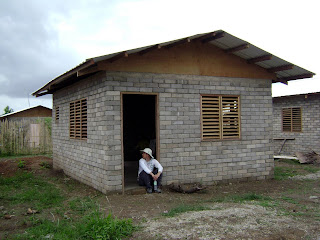

As is perhaps usual, we underestimated the village and its people.


In the Philippines, and perhaps in other developing nations, poverty seemed to be viewed in a completely different light.  Poverty simply is.  Some people are poor, and some people are not, and it is just the way life is.  I am sure that the poor would prefer to not be poor -- but because they do not assume that the wealthy are judging them, there is no need for embarrassment, defiance, or unease.  We began to see and understand this during the week, as we worked with and talked to the soon-to-be-owners of the houses we were building.  But it became crystal clear during the homestays.

Most families of the village have children; they are, after all, very Catholic (one family has 11!).  So most of the homestay families came equipped with a bunch of kids who were only too eager to teach their overnight guest card games, learn origami, or color pictures.  In one case, introduce the foreigner to the pet monkey in the backyard.

My family didn't have any kids -- or monkeys.  I was placed with one of the pillars of the community, a woman so busy she doesn't notice that her husband's job as an island caretaker keeps him away from home five days a week, and her two sons aged 15 and 20.


I spent most of the evening with the 20-year-old, who just come home from college in Manila (they essentially skip junior high, so they go college at 16 and finish at 20) and was about to begin teaching theology to kids the same age as my students.  This gave us plenty to talk about, and when we ran out of funny stories about our kids, we moved on to other topics such as the fact that I am already Catholic (so that he could stop trying to missionize me, which I think came as a relief to us both) and my marital status (my living away from my parents before marriage was a source of confusion to the point of anxiety for many of the Filipinos I met).

Perhaps the second-most surreal moment was when his mother tried to get me to marry him, then learning not two minutes later that he is strongly considering priesthood rather than teaching as a career.

The most surreal moment was definitely when we finished breakfast the next morning, and they realized they hadn't made good on their promise to sing karaoke with me the night before.  So they hooked up the machine and had us all singing Green Day -- at 6 in the morning!  However, it did prove the road to friendship with the 15-year-old, who before that hadn't said more than ten words to me.


I left in the morning with a handmade thank-you card, a request for photos of apple trees (I couldn't visualize a mango tree; my host mother couldn't visualize an apple tree), and a much better understanding of the lives of the people in "our" village.  They study in Manila and then come home to Palawan.  They have guitars and karaoke machines and dreams.  They open their doors and their arms to strangers.

Monday, May 18, 2009

Today

When I moved to this country, I knew that there would be quite a few surprises coming at me. I do not think I realized that I would spend every moment completely clueless as to what might happen to me in the next moment.

Today...

--one of my 3nensei boys decided it would be funny to pretend to have a crush on me all through lunch and 6th period. (At least I hope to God he was pretending.) For some reason, they haven't covered how to deal with hormonal teenage boys in our training. Why is this?

--another of my 3nensei boys asked if I was on a diet. Apparently my lunches are small. Jury's still out on whether he was asking because he thinks I should be on a diet.

--the same kid informed me that the art teacher and I would make a very nice couple.

--as they completed the sentence "~ makes me happy," I had to ask two of my girls if by "Beckham" they meant the actual soccer player or their homeroom teacher. (They meant the teacher.)

--I learned that, in Japan, Rock-Paper-Scissors is not only the arbiter of any disagreement and an amusing game in and of itself, but also the first step to another game that I had to play at least eight times before I actually understood.

--large numbers of my 2nensei students, in writing about their recent field trip, told me that they "played Zen meditation." The verb "suru" in Japanese can mean "do" or "play"...

--I found a snake coiled inside a drainage pipe on my walk home from school.

--I arrived home at 4.28 to find a contractor, whom I had told (through a translator) that I would be home by 4.30, waiting on my doorstep. He then proceeded to install a heated toilet seat with attached bidet and various other features I don't understand, which my landlord apparently decided I need.

Also, not today but recently...

--one of my 1nensei boys, in perfect seriousness, asked me if I am fluent in English.

--the tea lady offered me some fresh mountain greens, brought back from the 2nensei field trip. While I looked for chopsticks, she took my hand and deposited a mound of slimy, ice-cold greens into my palm. Mmm, oishii!

I had heard through the grapevine that many ex-JETs find post-Japan life to be rather boring. I mean, how could it not be?

[I'm not done with the Philippines; heavens, I still have over a week to talk about. But that's taking longer than expected...]

Tuesday, May 12, 2009

Habitat for Humanity Build Week, by the numbers

11: members of the Sendai JETs Global Village team

8: Americans

1: Canadian

1: Kiwi

1: Japanese

5: girls

6: boys

2: number of teams we were asked to divide into, as 5-6 is the ideal number for most of the tasks we were assigned to.

8: age of the Habitat Village in Puerto Princesa, Palawan

128: number of homes in the Village

400: goal number of homes for the Village


400: hours of “sweat equity” Habitat requires from prospective homeowners, which meant we worked side-by-side with the future inhabitants of the homes we were building. Getting to know them also meant that Team 1 and Team 2 later became known as Team Fidel and Team Randy.

>5: U.S. dollars per month required for rent. Rent can also be paid through labor, most frequently brick-making; there were two adults and three adolescent boys who spend most of their days making bricks -- when the foreigners aren’t taking up all their supplies of molds and shovels.

7+: hours each day during which the Village has no electricity (8 am to 3 pm). There are also unscheduled blackouts and brownouts (wherein there is electricity, but not enough to go around so some people don’t get any) relatively frequently. No power means no power tools, so everything from mixing concrete to pounding gravel into molds to make bricks is done by hand. There is also no running water, so all the water we used and the villagers drink either falls from the sky or is hauled up from the creek.

5: large piles of gravel that had been hauled up from the nearby creek, one in front of each house. The same gravel was used for everything: as-is for basic concrete, sifted for mortar, mixed with rocks (the rocks sifted out during the pre-mortar preparations) for the floor, and as a playground by the children.

10: number of bags of gravel, per one bag of cement mix, required for mortar and flooring.

6-8: number of buckets of water required for flooring, depending on how recently it rained.

30: minutes to mix a batch of concrete, pass it in buckets into the house, and spread it into a nice smooth floor.

8: batches of concrete required to complete a floor.

3: floors completed during the first three days.

80: shovelfuls of gravel, per one bag of cement mix, required for bricks.

113: bricks completed by 8 Sendai JET team members (5 in the morning and 8 in the afternoon) over the course of a 6-hour day. Not counting the ones that fell apart when we tried to remove them from the molds.

150: bricks completed in eight hours by one homeowner, who makes bricks to pay his rent.

3: number of wheelbarrows on site, used to move the bricks from the drying area to the under-construction house.

5-7: number of bricks that can be placed in each wheelbarrow at a time.

25ish: hours that one team or the other spent hauling bricks from one place to another.

1.5: depth, in meters, of the hole needed for sewage. (It was then to be covered with a concrete lid that would keep out the smell -- and, presumably, keep everyone from falling in a la Slumdog Millionaire.)


4: hours that Team 1 worked on The Hole for Fidel’s house.

>.5: depth, in meters, of The Hole at the end of those 4 hours.

3: meals provided on-site, by women whose cooking, I think, was their rent contribution to the month. It was lunch and two snack breaks (merendas) -- but they provided enough food for them each to be a meal in themselves.

4: approximate number of mangoes I ate every day. Not counting however many go into a mango smoothie, which I drank basically every dinner if they were on the menu.

2: grand total of Tagalog phrases learned. Salamat po = Thank you. Magandan umaga = Good morning.

3.5: hours required for the children to overcome their shyness; ie, until lunch the first day. After that, we all had lots (and lots) of new friends. Their favorite game was to learn all our names, then shout them one by one to see how long it would take us to turn and wave. This game was especially fun if they were up in a tree or hiding behind something.

3.5: days of brutal sun and temperatures in the 90s. From Monday through mid-day Thursday we all burnt to an absolute crisp and sweated enough that we had to keep an eye on ourselves and each other to prevent dehydration. But just after lunch on Thursday (and just after mixing a fresh batch of concrete), the engineer came running up calling “Stop! Stop! The rains are come!” The rains, as it turned out, were torrential and not quite so brief as torrential rains I’m used to. That was the beginning of the working-while-constantly-wet and smelling-like-rainwater-all-the-time phase.

2: long-suffering souls provided to keep an eye on our stuff during the day and keep an eye on us at whatever shopping outlet/dangerous part of town we decided to explore after work.

3: number of days on which we decided to delay showers so as to explore and/or purchase necessities like non-Japanese sunscreen (ie, sunscreen that might have a chance of working) and aloe (because Japanese sunscreen doesn't work).

: stares intercepted as we wandered around splattered in an aromatic mixture of sweat, rain, concrete, and mud. Plus the pricelessly polite comment from a store clerk: “Why are you wet, ma’am?”

2: (air-conditioned) vans and drivers provided to transport us to the Village and then back to the hotel -- and to whichever restaurant we chose for dinner.

90: preferred speed, in kph, of Roy and Lolo, our drivers.

30: average speed of a tricycle on the National Highway.


2: number of lanes on the National Highway, not counting the equally-wide footpaths on either side. Also the number of solid yellow lines running down the middle of the road most of the time.

24: other vehicles passed during the drive on Friday.

60: minutes required to drive from the hotel to the Village.

45: minutes required when we were running late on Monday morning. We tried very hard to never be late again.

2001: average year of release of the American pop songs we heard on the radio.

1986?: year of release of the CD of Filipino favorites they unearthed to play for us whenever there was electricity. Just whistle while you work -- or, rather, sing along to songs whose words you will soon memorize even though they aren’t in your language. I still have “Oomba Papalicious” running through my head.

5: homes dedicated and occupied by their new owners in a ceremony on Friday afternoon.

Monday, May 11, 2009

Tadaima!

Loosely translated, I’m back!


I arrived back in Sendai at 5.45 am on Sunday morning, about an hour ahead of schedule. I have now unpacked all my bags, and the physical evidence of the trip is hanging to dry, put away, or neatly displayed. I wish that coming to terms with everything I’ve seen in the past two weeks was that easy.


Sorting through my reactions, to say nothing of my stories and photos, and deciding what to share is going to take a while. I promise there will be full blog coverage eventually. For now, I will leave you with a short list of things that I didn’t know I didn’t know:

--Poverty means nothing to a child. There are worse places to grow up than a village with a hundred other kids, scaffolding, giant piles of gravel, and foreigners to play with.


--Manila is a good example of a worse place to grow up.


--I am 23, unmarried, and childless. Therefore, I fail at life. (I learned this from a couple of middle-aged men on a bus in Bohol. They also had a lot of trouble accepting that I was not married or attached to either of the two boys I was travelling with.)


--People in Bohol are honored that foreigners would come to their island; they don’t consider it worthy of visiting because everyone is so poor. (This was after we established the depth of my reproductive failure.)

Thursday, April 23, 2009

why do i always do this?

two days before i left for my first year mta, i gave myself 2nd-degree burns on my wrist with hot coffee.

twenty-four hours before leaving to build houses in a poverty-stricken area of the philippines, i have cut my finger with a kitchen knife i was trying to wash.

bad timing, jennifer!!!

however, sitting here with only one useful hand (hence the lack of capitals) means that i was looking around for stuff to waste time with, and created this. pretty, eh? apparently i think a lot.

so yeah, tomorrow night i leave for the philippines for two weeks, one to be spent building houses with habitat for humanity and one to be spent gallivanting. full update, with photos, will follow. i promise.

one-handed typing is annoying me now.

Tuesday, April 7, 2009

Things I Didn't Know Then

On 3 April 2008, I received my JET Program acceptance email from the Japanese Consulate in Boston. I still remember the rush -- of relief, of pride, of sheer unadulterated glee. I also remember knowing on a rational level that I had no idea what I was getting myself into -- but feeling so on top of the world that I was sure I'd be fine.

Well, I was fine. But I definitely did have no idea what I was getting myself into.

What I Know Now. What I'm Not Sure If I Wish I Knew Then.

(these are in whatever order they happened to occur to me, which may in itself reveal something)

  • that "kawaii" is the highest possible compliment for any woman under the age of thirty or any item that she owns.
  • that "kawaii" literally translates as "cute" but really means anything from pretty and fashionable to idiotic and Hello Kitty.
  • that travel doesn't happen when you're facing a snowstorm on the one hand and a warm kotatsu on the other.
  • that no one in Japan speaks fluent English.
  • that everyone in Japan speaks more English than they'll admit at first.
  • that being American is boring. They import too many of us.
  • that being blonde is the most exciting event of the day to whoever is staring at you/talking about you/taking your picture. It doesn't matter how many of us they import.
  • that I would become a pesco (fish-eating) vegetarian when with my colleagues.
  • that being a pesco vegetarian would be difficult and confusing enough.
  • that the Japanese do not understand the concept of vegetarianism.
  • that cherry blossom is a flavor, not just a flower.
  • that balls of salted rice wrapped in seaweed would come to be considered food, and a staple food at that.
  • that I would miss ovens and cheese and dense baked goods.
  • that manga and anime are not confined to 20somethings with bad teeth.
  • that businessmen read manga on the subways.
  • that Buddhist monks ride subways.
  • that it is not a stereotype that Japanese people get their l's and r's confused. They have trouble with b's and v's too.
  • that it is a stereotype that Japanese students are well-behaved angels who love English.
  • that Japan struggles with a high suicide rate among its students.
  • that the life span of a Japanese pop star is three months.
  • that you can't keep up with the Japanese pop scene, so don't try.
  • that I wouldn't be able to imagine leaving.
  • that it could take six months to get over the culture shock and the homesickness.
  • that maybe I was destined to be a teacher all along.
  • that you can miss your adopted homeland as much as your real homeland.
  • that a bicycle is the way to go -- anywhere.
  • that anything cut below the collarbone is risque, but pants are optional.
  • that you learn things from drunken colleagues that would never come out in the staff room.
  • that Canadians don't have anything on the Japanese when it comes to effective use of the word "eh."

Saturday, March 14, 2009

Why I Have So Little to Say

I have been a very bad blogger lately... two posts in three months, tsk tsk tsk. The problem is, I have been saving all my money for a massive Habitat for Humanity-based trip to the Philippines (someday I will learn to spell that right the first time around) at the very end of April. So local travel, which is less expensive but still expensive, given that this is Japan, has been pretty well cut off for the moment.

Plus it's too bloody cold to do anything of particular interest. When I go out with friends, it is typically to curl up in each other's apartments under kotatsus and eat hot food while discussing our schools and kids. Exciting, no? I just cannot stir up any enthusiasm to travel to a different town and look at their snow, dead gardens, and cold streets.

I have also been too busy, and then exhausted from the busyness, to do much. The new school year (as well as the new fiscal year, but that's not really relevant) begins in April in Japan. So we have all been extremely busy gearing up for graduation of the 3nensei, and now gearing up for the end of the year for everyone else and then the beginning of the year. You know a school has a lot going on if they are finding things for even the permanently-confused foreign teacher to be doing to help.

Which brings me to the main point: I am considering dropping my self-imposed ban on talking about my school and my kids here. I have resisted doing so mainly because it doesn't seem particularly ethical to talk about people without their knowledge or consent. It also seems like it could be really embarrassing (another word I need to learn to spell) if someone from the school stumbled onto this blog and discovered that I'd been saying things they didn't approve of.

On the other hand...

1. They blog about me.

2. If I only said the things that were positive, could they really complain?

3. So many other JETs blog about their schools. I know, I know... but yes, if everyone else jumped off a bridge I probably would too. I like to swim.

4. It would give me something to say during these long intervals (known as "winter") when nothing else is happening.

Hm.


(School, from various angles. A place I may be talking about more in detail in the future?)